Rush Hour CCTV Strategies: Prediction Tips & Analysis
Mathematical breakdown of every Rush Hour betting approach. Honest RTP analysis, bankroll management frameworks, and myth busting backed by numbers — not promises.
No Strategy Beats the House Edge
The house edge of 6.5–8.5% means the casino always profits over the long term. Every strategy discussed on this page is designed to manage your experience and control losses — not to generate income. Rush Hour is a gambling product, and the mathematical structure ensures that the operator retains a percentage of all money wagered over time.
If you wager $1,000 across many rounds, you should expect to receive back between $915 and $935 on average. The remaining $65–$85 is the cost of playing. Short-term results will vary — you may win more or lose more in any given session — but the long-term trend always favors the house.
If you are experiencing financial difficulty or gambling feels like a compulsion rather than entertainment, please visit our Responsible Gaming page for support resources.
The Math Behind Rush Hour CCTV
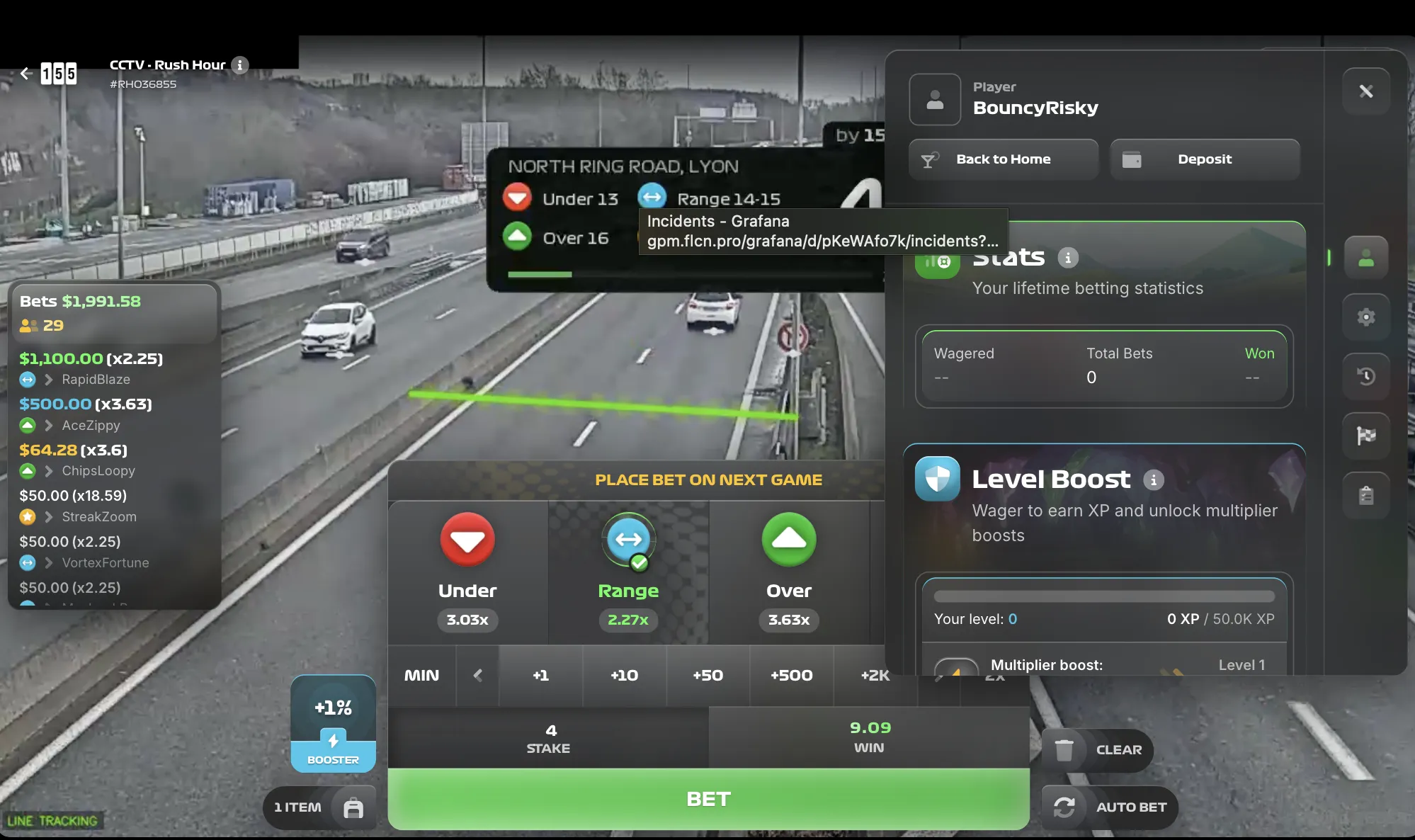
Rush Hour game interface with live CCTV feed, betting panel, and player statistics
Before examining any strategy, you need to understand the numbers that govern every round of Rush Hour. These are not opinions or estimates — they are the mathematical framework that determines outcomes over time. Regardless of which strategy you choose, these numbers apply to every single bet you place.
Return to Player (RTP) Explained
RTP stands for Return to Player, expressed as a percentage. Rush Hour's RTP ranges from 91.50% to 93.50% depending on the bet type selected. This number represents the theoretical percentage of all wagered money that the game returns to players over an extremely large number of rounds — typically hundreds of thousands or millions.
Here is what that looks like in practice with a €1,000 total wager example:
| Bet Type | RTP | Expected Return on €1,000 | Expected Loss on €1,000 |
|---|---|---|---|
| Pick Winner | ~93.50% | €935.00 | €65.00 |
| Any Order | ~92.50% | €925.00 | €75.00 |
| Exact Order | ~91.50% | €915.00 | €85.00 |
These are long-term averages. In a single session of 50 rounds, your actual results could be significantly higher or lower. That variance is what makes gambling feel unpredictable — and why some players mistakenly believe they have found a winning system after a few good sessions.
House Edge Calculation
The house edge is simply 100% minus the RTP. For Rush Hour:
- Pick Winner: 100% − 93.50% = 6.50% house edge
- Any Order: 100% − 92.50% = 7.50% house edge
- Exact Order: 100% − 91.50% = 8.50% house edge
For comparison, blackjack with basic strategy has a house edge under 1%. European roulette sits at 2.7%. Most crash games operate between 3% and 5%. Rush Hour's house edge is higher than all of these, which means your bankroll depletes faster relative to the number of bets placed. This is not a reason to avoid the game entirely — many players find the CCTV format worth the premium — but it is a reality you must factor into your approach.
Variance vs Expected Value
Expected value (EV) is what you will average over tens of thousands of rounds. Variance is how much your results swing above and below that average in shorter time frames. Rush Hour has medium volatility, which means:
- You will not experience the extreme swings of high-volatility slots (where 500 dead spins followed by a massive win is normal)
- You will not experience the steady, small fluctuations of low-volatility games like baccarat
- Sessions of 50–100 rounds will show noticeable ups and downs, but rarely catastrophic swings
The practical takeaway: a session with 50 rounds at $1 per bet ($50 total wagered) could end with you up $10 or down $20. Both are within normal variance. Over 5,000 rounds at $1 per bet ($5,000 total wagered), you will almost certainly be down $325–$425 — the expected house take on that volume.
The Gambler's Fallacy — Debunked
The gambler's fallacy is the belief that past results influence future outcomes in independent events. In Rush Hour, each round uses a fresh CCTV observation window. The pedestrians and vehicles captured in one 55-second round have no connection to those in the next round. If the "over" result has hit five times in a row, the probability of "over" on the next round is exactly the same as it always was.
Traffic patterns do show some time-of-day trends (more people during rush hours, fewer at night), but within any given time block, individual round outcomes are effectively independent. A camera showing 12 pedestrians in one round does not make 8 pedestrians more or less likely in the next round. The city does not "owe" you a low count because you have seen several high counts.
This fallacy is the single most expensive misconception in gambling. It drives chase behavior, where players increase bets after losses because they believe a win is "due." It is not. Each round is its own event.
Strategy 1: Conservative Approach (Low Risk)
The conservative strategy prioritizes longevity and controlled losses. It is designed for players who view Rush Hour as entertainment and want to maximize their play time for a given budget. This approach will not produce large wins, but it significantly reduces the chance of fast bankroll depletion.
Core Principles
- Bet type: Pick Winner only (~93.5% RTP). This is the highest-RTP option and produces the most consistent results.
- Stake size: Maximum 1% of your session bankroll per round. With a €100 bankroll, that means €1 bets.
- Session time limit: 60 minutes maximum, regardless of whether you are winning or losing.
- Session money limit: Stop if you lose 30% of your starting bankroll. Stop if you gain 50% of your starting bankroll.
Bet Sizing Table for Conservative Strategy
| Session Bankroll | Max Bet (1%) | Expected Rounds Before Depletion | Estimated Session Time |
|---|---|---|---|
| €50 | €0.50 | ~90–120 rounds | ~80–110 minutes |
| €100 | €1.00 | ~90–120 rounds | ~80–110 minutes |
| €200 | €2.00 | ~90–120 rounds | ~80–110 minutes |
| €500 | €5.00 | ~90–120 rounds | ~80–110 minutes |
The expected rounds remain roughly the same regardless of bankroll size because you scale the bet proportionally. With Pick Winner bets at 93.5% RTP and 1% bet sizing, the house edge erodes your bankroll at approximately 0.065% per round (6.5% of 1%). That translates to roughly 100 rounds of comfortable play before variance starts compressing your balance toward zero.
Who This Strategy Suits
The conservative approach works best for players who treat Rush Hour as a form of paid entertainment — similar to buying a movie ticket or a concert entry. You are paying for the experience of watching live CCTV feeds and making predictions, with the understanding that the entertainment has a cost. At €1 bets on a €100 bankroll, that cost averages around €6.50 per hour. Compare that to other forms of entertainment to decide if the value makes sense for you.
This strategy does not suit players chasing big payouts. The maximum win on a Pick Winner bet is modest compared to Exact Order. If you want the chance at 18x returns, you need to accept higher risk — covered in Strategy 3.
Strategy 2: Pattern Observation (Medium Risk)
The pattern observation strategy adds a layer of information gathering to your betting decisions. Because Rush Hour uses real CCTV footage from actual city locations, there are genuine patterns in traffic flow that vary by time of day, day of week, and camera location. This strategy attempts to use that information — while being honest about its severe limitations.
What You Can Observe
- Time-of-day traffic volume: Morning rush (7–9 AM local time) and evening rush (5–7 PM) consistently show higher pedestrian and vehicle counts. Late night (11 PM–5 AM) shows the lowest activity. This is the most reliable observable pattern.
- Camera location characteristics: A camera overlooking a busy intersection in Tokyo will produce different count ranges than a suburban street in Eastern Europe. Familiarize yourself with the location before betting.
- Weather and seasonal effects: Rain visibly reduces pedestrian counts. Summer evenings tend to show more foot traffic than winter evenings. These factors are observable in the live feed.
- Special events: Occasionally, local events (sports matches, concerts, parades) cause unusual spikes in activity near camera locations.
The Watch-Then-Bet Protocol
Before placing your first bet on any camera location, watch 2–3 full rounds without betting. During this observation period:
- Note the general traffic volume — is it a busy period or quiet?
- Count the approximate range of pedestrians or vehicles crossing the observation zone per round
- Look for any unusual conditions (construction, road closures, weather changes)
- Decide your target count range based on what you have observed
Recommended Bet Type: Any Order
The pattern observation strategy pairs well with Any Order bets. You are making informed predictions about count ranges, and Any Order rewards getting the right numbers without requiring the exact sequence. The RTP of approximately 92.50% sits between the safety of Pick Winner and the risk of Exact Order, matching the medium-risk profile of this approach.
Historical Pattern Limitations
Traffic observation can marginally improve your prediction accuracy compared to blind guessing. But the margin is small, and it is difficult to quantify precisely. Treat pattern observation as a way to make more informed decisions, not as a system that changes the underlying mathematics of the game.
One common trap: players who spend time observing start to feel more confident in their predictions than the data warrants. That confidence leads to larger bets, which increases the rate of loss. Stay disciplined with bet sizing regardless of how "certain" you feel about a particular round.
Strategy 3: Calculated Risk (High Risk)
The calculated risk strategy is designed for players who accept higher potential losses in exchange for the possibility of larger payouts. This approach uses Exact Order bets, which offer the maximum 18x multiplier but carry the lowest RTP at approximately 91.50%.
Exact Order Bet Mechanics
An Exact Order bet requires you to predict the precise count and sequence of pedestrians or vehicles in the observation window. Because the prediction must be exact, the probability of winning any individual bet is lower — but the payout when you do win is substantially higher. The 18x maximum multiplier means a $10 bet returns $180 on a correct prediction.
Short Session Approach
With an 8.5% house edge, the mathematics work against you faster than with Pick Winner bets. The calculated risk strategy compensates by using very short sessions:
- Session length: 10–15 rounds maximum. At 55 seconds per round, that is roughly 10–14 minutes.
- Bet sizing: 2% of bankroll per round (higher than conservative, reflecting the higher-risk profile).
- Target: One or two winning bets per session. If you hit an 18x win early, stop. If you reach 10 rounds without a win, stop.
- Frequency: Limit yourself to one or two high-risk sessions per week.
Why Martingale Fails — The Mathematical Proof
Many players attempt a Martingale-style approach with high-risk bets: double the bet after each loss so that the first win recovers all losses. Here is why this fails with mathematical certainty:
Assume you start with a $1 Exact Order bet and double after each loss:
| Round | Bet Amount | Total Invested | Win at 18x Pays | Net Profit if Win |
|---|---|---|---|---|
| 1 | $1 | $1 | $18 | +$17 |
| 2 | $2 | $3 | $36 | +$33 |
| 3 | $4 | $7 | $72 | +$65 |
| 4 | $8 | $15 | $144 | +$129 |
| 5 | $16 | $31 | $288 | +$257 |
| 6 | $32 | $63 | $576 | +$513 |
| 7 | $64 | $127 | $1,152 | +$1,025 |
| 8 | $128 | $255 | $2,304 | +$2,049 |
| 9 | $256 | $511 | $4,608 | +$4,097 |
| 10 | $512 | $1,023 | $9,216 | +$8,193 |
By round 10, you need $512 for a single bet and have invested $1,023 total. Most casino table limits will cap you well before this point. More critically, the probability of losing 10 consecutive Exact Order bets is significant — with a win probability around 5.5% per round, the chance of 10 consecutive losses is approximately 56%. That means more than half of all Martingale sequences of 10 rounds will fail completely.
The Martingale does not change the expected value of your bets. It simply redistributes your losses into rare but catastrophic events. Over hundreds of sessions, you will experience those catastrophic losses, and they will more than offset all the small wins accumulated along the way. This is not speculation — it is a mathematical certainty given sufficient sample size.
When Calculated Risk Makes Sense
The high-risk approach is appropriate only when you have allocated a specific amount of money that you are genuinely comfortable losing entirely, and when you are looking for a short, high-intensity session rather than extended play. Think of it as buying a lottery ticket rather than paying for an evening of entertainment. The expected cost is higher, but the potential single-round payout is much larger.
Bankroll Management for Rush Hour CCTV
Bankroll management is the only aspect of Rush Hour where you have genuine control. You cannot control the CCTV outcomes, the RTP, or the house edge. You can control how much you deposit, how much you bet per round, when you stop, and how frequently you play. Every strategy discussed on this page depends on disciplined bankroll management to function.
The 1% Rule Explained
The 1% rule is straightforward: never risk more than 1% of your current session bankroll on a single round. If you sit down with $100, your maximum bet is $1. If your balance drops to $80, your maximum bet becomes $0.80. If your balance rises to $130, you can increase to $1.30.
This scaling accomplishes two things. First, it prevents a short losing streak from wiping out your session. A streak of 10 consecutive losses at 1% bet sizing costs you approximately 9.6% of your bankroll (slightly less than 10% because each successive bet is on a smaller balance). Compare that to a player betting 10% per round — the same 10-round losing streak would consume 65% of their bankroll.
Second, the 1% rule naturally slows your play as your balance decreases, giving you more rounds (and more entertainment) from a diminishing bankroll. It functions as an automatic brake that becomes more conservative as you approach your loss limit.
Session Limits: Time and Money
Set both limits before you start playing, and enforce them without exception:
- Time limit: 60 minutes maximum for conservative play, 15 minutes for high-risk play. Set a timer on your phone. When it goes off, you stop — regardless of your balance.
- Loss limit (stop-loss): Stop if you lose 30% of your starting bankroll. With a $100 start, that means you stop at $70. This preserves the majority of your bankroll for future sessions.
- Win limit (take-profit): Stop if you gain 50% of your starting bankroll. With a $100 start, that means you stop at $150. Locking in profits prevents the common pattern of winning and then losing it all back in extended play.
Stop-Loss and Take-Profit Psychology
The hardest part of bankroll management is enforcement. When you hit your stop-loss, you will feel the urge to "win it back." When you hit your take-profit, you will feel like you are on a hot streak and should keep going. Both impulses are driven by emotional responses, not rational analysis.
The math does not change based on your session history. If you have lost 30% of your bankroll, the house edge on your next bet is exactly the same as it was on your first bet. You are not "due" for a recovery. Similarly, if you are up 50%, the house edge on your next bet is identical. The game does not know or care about your running total.
Pre-commit to your limits by writing them down before you play. Some players find it helpful to set a physical reminder — a note next to their screen or a phone alarm. Casino platforms also offer deposit limits and session timers in their responsible gambling tools. Use them.
Emotional Control and Tilt Awareness
Tilt is a poker term for emotional decision-making that overrides rational strategy. In Rush Hour, tilt typically manifests as:
- Increasing bet sizes after losses to "recover" faster
- Switching from Pick Winner to Exact Order bets when losing, chasing the 18x multiplier
- Ignoring session limits because "one more round" will change everything
- Depositing additional funds beyond your planned session bankroll
If you notice any of these behaviors in yourself, stop playing immediately. Close the browser or app. Come back another day. There is no Rush Hour round worth making financial decisions from an emotional state. The game runs 24 hours a day, 7 days a week — it will still be there when you are calm and thinking clearly.
Rush Hour Myths Debunked
The internet is full of Rush Hour "systems" and "guaranteed strategies." None of them work. Here are the most common myths and why they fail, backed by the mathematics of the game.
Myth 1: "The Game Is Due for a Win"
This is the gambler's fallacy in its purest form. After a string of losses, many players believe the next round is more likely to produce a win. This is false. Each 55-second CCTV observation window is an independent event. The pedestrians walking through a camera zone at 3:15 PM have no connection to those who walked through at 3:14 PM.
The probability of any specific outcome does not change based on previous rounds. If Pick Winner bets have a 50% win rate (approximate), then after 5 consecutive losses, the probability of winning the 6th bet is still 50% — not higher. The sequence of past results has no influence on the next independent event.
Myth 2: "Betting Systems Guarantee Profit"
Martingale, Fibonacci, D'Alembert, Labouchere — every progressive betting system shares the same fatal flaw. They change the distribution of wins and losses without changing the expected value. The house edge applies to every bet regardless of your bet sizing pattern.
Here is a simple proof: if your expected loss on a single $1 bet is $0.065 (6.5% house edge), then your expected loss on 100 bets of varying sizes that total $1,000 in wagers is $65. It does not matter whether those bets were $1 each, or $1 followed by $2 followed by $4, or any other sequence. The total expected loss is always the house edge multiplied by the total amount wagered.
Betting systems create the illusion of working because they produce many small wins and rare large losses. Over short periods, you may see only the small wins and conclude the system works. But the large losses will come eventually, and they will erase those accumulated small wins. This is not a matter of "if" but "when."
Myth 3: "Higher Bets Improve RTP"
The RTP of Rush Hour is fixed by the payout structure, not by your bet size. A $0.50 Pick Winner bet has exactly the same 93.5% RTP as a $500 Pick Winner bet. Increasing your stake increases the absolute dollar amount you can win or lose, but it does not change the percentage the house takes.
Some players confuse this with slot games where higher denominations sometimes offer better RTP. That mechanic does not exist in Rush Hour. The house edge is consistent regardless of bet size.
Myth 4: "You Can Read Traffic Patterns Reliably"
As discussed in Strategy 2, broad traffic patterns are real — rush hours are busier than midnight, weekdays differ from weekends. But the specific count in any given 55-second window has too much randomness to predict reliably. A busy intersection might average 15 pedestrians per minute, but the standard deviation around that average is large enough that individual round counts swing widely.
Players who believe they can "read" traffic patterns often fall victim to confirmation bias — they remember the rounds where their prediction was correct and forget the ones where it was wrong. Keeping an honest written record of predictions versus outcomes will quickly reveal that traffic reading provides, at best, a marginal improvement over random guessing — nowhere near enough to overcome the 6.5–8.5% house edge.
Rush Hour Strategy Comparison
The table below summarizes all three strategies side by side. Choose the approach that matches your risk tolerance, bankroll size, and entertainment goals.
| Strategy | Risk Level | Recommended Bet Type | RTP | Session Length | Best For |
|---|---|---|---|---|---|
| Conservative | Low | Pick Winner | ~93.5% | 60–90 minutes | Extended entertainment, bankroll preservation |
| Pattern Observation | Medium | Any Order | ~92.5% | 30–60 minutes | Engaged players who enjoy analysis, balanced risk |
| Calculated Risk | High | Exact Order | ~91.5% | 10–15 minutes | Short, high-intensity sessions seeking large payouts |
No strategy is objectively "best." The conservative approach gives you the most play time and the slowest bankroll erosion. The calculated risk approach gives you the chance at the 18x multiplier but burns through bankroll quickly. The pattern observation strategy sits in the middle and adds an analytical element that many players find engaging, even if its practical edge over random betting is modest.
You can also combine approaches within a session. A common hybrid is to play 80% of your rounds with conservative Pick Winner bets and allocate 20% to Any Order or Exact Order bets. This provides the stability of the conservative approach with occasional shots at larger payouts. Just ensure your overall bet sizing stays within your bankroll management framework.
Rush Hour CCTV Strategies: Frequently Asked Questions
No. The house edge of 6.5–8.5% is built into every bet type. Over thousands of rounds, the casino always profits. Strategies can manage variance and extend session length, but they cannot eliminate the mathematical advantage held by the operator. Anyone claiming a guaranteed winning system is either misinformed or dishonest. The best you can do is choose the approach that matches your risk tolerance and entertainment budget.
Pick Winner bets offer the highest RTP at approximately 93.5%, making them the lowest-risk option. The house edge on Pick Winner is around 6.5%, compared to 8.5% on Exact Order bets. While the payouts are smaller, the higher win frequency means less variance and longer play sessions for the same bankroll. If your priority is maximizing entertainment time per dollar spent, Pick Winner is the clear choice.
No. The Martingale system (doubling your bet after each loss) fails for three reasons: table limits cap your maximum bet before the sequence can recover, bankroll limits mean you run out of money during losing streaks, and the house edge applies to every bet regardless of size. A 10-round losing streak requires 1,024 times your starting bet, and such streaks occur more often than most players expect. The Martingale does not change the expected value — it simply concentrates your losses into rare but devastating events.
Using the 1% rule (never risking more than 1% of your bankroll per round), a $100 bankroll means $1 maximum bets. At that rate with Pick Winner bets, you can expect roughly 90–120 rounds before your bankroll is depleted by the house edge, which translates to about 80–110 minutes of play. The key principle is: only bring money you can afford to lose entirely. Your session bankroll should be an amount that, if lost completely, causes zero financial hardship.
Watching 2–3 rounds before placing bets can help you understand the current camera location and traffic conditions. During rush hour periods, pedestrian and vehicle counts tend to be higher and more predictable. However, this observation provides limited statistical edge because traffic patterns contain significant randomness at the individual-round level. Treat observation as information gathering rather than as a reliable prediction method. It will not overcome the house edge, but it may help you avoid obviously poor predictions on unfamiliar camera locations.
Rush Hour's RTP of 91.5–93.5% is comparable to mid-range slots and slightly below many crash games (which often offer 95–97% RTP). The advantage of Rush Hour is the real-world CCTV element, which some players find more engaging and transparent than RNG-based games. The disadvantage is the relatively high house edge. The "best" game is subjective and depends on your entertainment preferences, risk tolerance, and how much you value the live-content format over pure mathematical favorability.
Traffic volume varies predictably throughout the day. Morning rush (7–9 AM local camera time) and evening rush (5–7 PM) typically show higher pedestrian and vehicle counts. Late night hours show lower counts. While these broad patterns are real and observable, the exact count in any given 55-second round remains unpredictable due to natural randomness. Time-of-day awareness can inform your general predictions but does not provide a reliable edge over the house. The house edge of 6.5–8.5% applies at all hours.
Continue Learning About Rush Hour
Explore our other guides to get the full picture of Rush Hour by 155.io:
Complete rules guide covering all three bet types, round mechanics, multipliers, and payout structures. Start here if you are new to the game.
Read the Rules →Practice Rush Hour predictions with virtual credits. No registration or deposit required on most platforms. Test all three strategies risk-free.
Try the Demo →Compare welcome bonuses, cashback offers, and free spins across all Rush Hour casino partners. Updated monthly with current promotions.
View Bonuses →Learn about Sarah Chen's review methodology, credentials, and editorial independence. All strategy analysis is data-backed and honestly presented.
About Us →Our full independent review covering RTP data, streaming quality, casino partners, and honest verdict. Includes player testimonials and expert rating.
Read Full Review →